

Waste-Derived Pyrolysis Oil Market Outlook: Price Trends, Production Capacity and Demand Forecast (2026–2036)
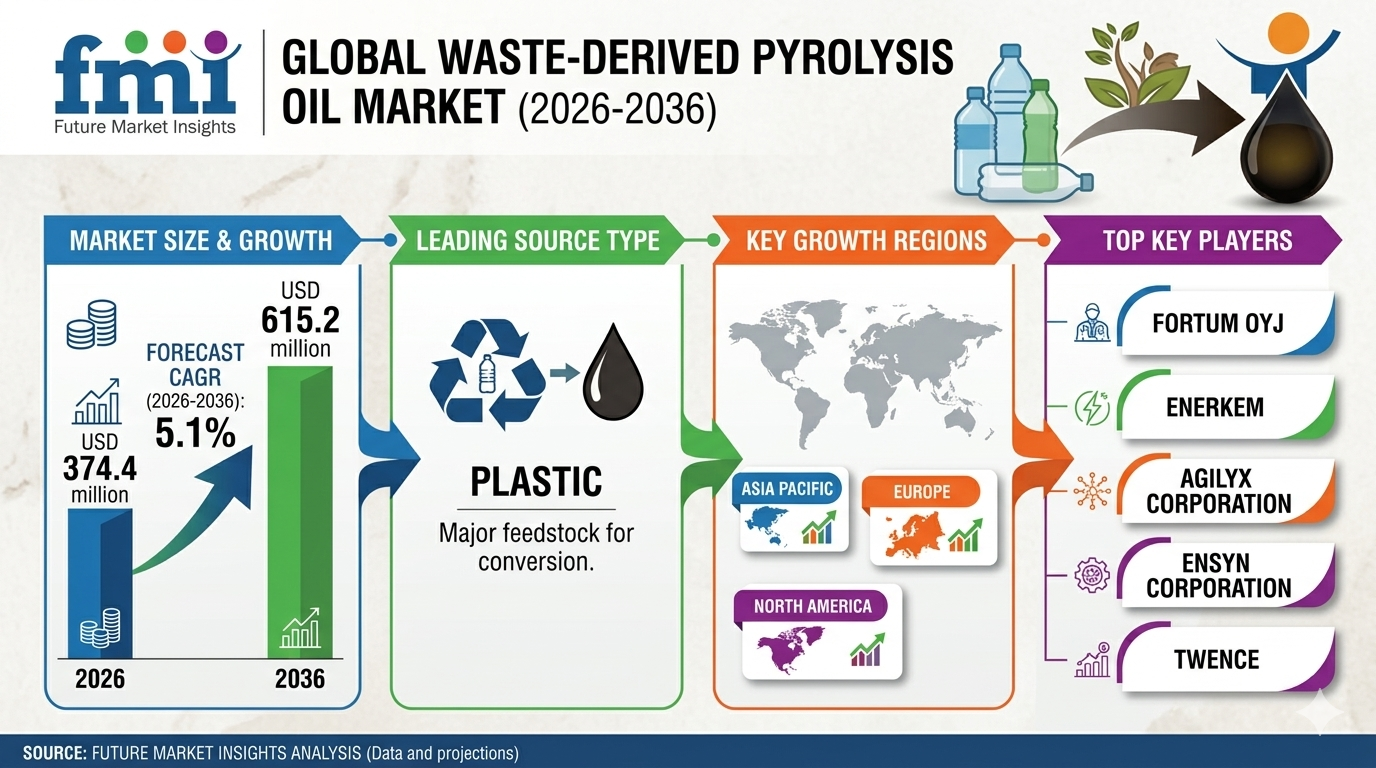
Growing focus on waste-to-energy solutions and circular economy initiatives drives steady global market expansion
NEWARK, DE, UNITED STATES, March 23, 2026 /EINPresswire.com/ -- The global Waste-Derived Pyrolysis Oil Market is valued at USD 374.4 million in 2026 and is projected to reach USD 615.2 million by 2036, expanding at a CAGR of 5.1% from 2026 to 2036. Growth is supported by increasing efforts to reduce landfill dependency, convert complex waste streams into usable energy, and integrate recycled inputs into industrial value chains.
As industries seek alternatives to conventional fossil fuels, waste-derived pyrolysis oil is evolving from a niche waste-management output into a viable industrial fuel and chemical feedstock. Produced through the thermal decomposition of plastics, biomass, tires, and mixed waste in oxygen-free environments, pyrolysis oil is gaining strategic importance in energy transition and circular economy frameworks.
Waste-Derived Pyrolysis Oil Market Snapshot (2026–2036)
• Market size in 2026: USD 374.4 million
• Market size in 2036: USD 615.2 million
• CAGR (2026–2036): ~5.1%
• Leading source type: Plastic-derived feedstock
• Top end-use segment: Heat & power applications
• Dominant process: Fast pyrolysis
• Fastest-growing country: India
• Key players: Global waste-to-energy and chemical recycling companies
Market Momentum
The market begins at USD 374.4 million in 2026, driven by growing demand for sustainable fuel alternatives and improved waste management systems. Between 2027 and 2030, rising investments in commercial-scale pyrolysis plants and increasing policy support accelerate adoption across industrial sectors.
From 2031 onward, advancements in oil upgrading, impurity reduction, and refinery integration strengthen commercial viability. By 2036, the market reaches USD 615.2 million, supported by broader adoption in industrial heating, power generation, and petrochemical applications.
Request For Sample Report | Customize Report |purchase Full Report - https://www.futuremarketinsights.com/reports/sample/rep-gb-11058
Why the Market is Growing
The Waste-Derived Pyrolysis Oil Market is expanding as governments and industries prioritize landfill reduction and low-carbon energy solutions. Pyrolysis oil provides a pathway to recover value from non-recyclable waste while reducing dependence on virgin fossil fuels.
Refineries and petrochemical producers are increasingly adopting pyrolysis oil for blending and chemical feedstock applications. The ability to incorporate recycled content into polymers and fuels aligns with sustainability mandates and corporate ESG targets.
Additionally, government regulations—including landfill bans, carbon pricing, and waste-to-energy incentives—are encouraging investments in pyrolysis infrastructure. These policies are making projects more economically viable and accelerating commercialization.
Segment Spotlight
1. Source: Plastic Feedstock Leads Demand
Plastic-derived pyrolysis oil accounts for approximately 44% of total market share. Its consistent composition, high liquid yield, and abundant availability from municipal and industrial waste streams make it the preferred feedstock.
2. End Use: Heat & Power Dominates Utilization
Heat and power applications represent nearly 40% of demand, driven by industrial boilers, combined heat and power systems, and distributed energy setups seeking lower-emission fuel alternatives.
3. Process: Fast Pyrolysis Remains Industry Standard
Fast pyrolysis holds about 62% share due to its scalability, efficiency, and ability to handle diverse feedstocks while delivering high liquid yields.
Drivers, Opportunities, Trends, Challenges
Drivers:
• Rising plastic and industrial waste generation
• Strong regulatory push for landfill diversion
• Increasing demand for low-carbon fuels
Opportunities:
• Refinery co-processing and chemical recycling integration
• Expansion of modular pyrolysis plants
• Growth in circular economy initiatives
Trends:
• Strategic partnerships across waste, energy, and chemical sectors
• Advancements in feedstock pre-treatment and oil upgrading
• Increased adoption of certification frameworks for low-carbon fuels
Challenges:
• Feedstock variability and contamination issues
• High capital investment for plant development
• Lack of standardized fuel quality specifications
Country Growth Outlook (2026–2036)
India leads the market with a projected CAGR of 6.2%, driven by rapid adoption of waste-to-energy technologies and strong policy support for plastic waste management. China follows at 5.5%, supported by large-scale industrial integration and refinery co-processing initiatives.
Europe remains a key region, with countries like France, Germany, and the United Kingdom advancing through circular economy regulations and renewable energy incentives. The United States continues steady growth with increasing investments in modular pyrolysis systems and chemical recycling.
Competitive Landscape
The market is characterized by a mix of technology providers, waste management companies, and energy firms focusing on improving conversion efficiency, feedstock flexibility, and oil quality.
Key participants such as Fortum Oyj, Enerkem, Agilyx Corporation, Ensyn Corporation, and Twence are investing in advanced reactor technologies, upgrading systems, and scalable plant designs.
Simultaneously, major energy companies including Shell, TotalEnergies, and ExxonMobil are integrating pyrolysis oil into refinery and chemical production processes, strengthening commercialization pathways.
Competition is increasingly centered on product consistency, lifecycle emissions performance, secure feedstock supply, and long-term offtake agreements.
Frequently Asked Questions (FAQ)
What is the global Waste-Derived Pyrolysis Oil Market size?
The market is valued at USD 374.4 million in 2026 and is projected to reach USD 615.2 million by 2036.
What is the expected growth rate?
The market is forecast to grow at a CAGR of approximately 5.1% from 2026 to 2036.
What is waste-derived pyrolysis oil?
It is a liquid fuel produced by thermally decomposing waste materials such as plastics, biomass, and tires in an oxygen-free environment.
Why is pyrolysis oil gaining importance?
It enables waste valorization, reduces landfill dependency, lowers emissions, and provides a sustainable alternative to conventional fossil fuels.
Explore More Related Studies Published by FMI Research:
Anode Foil Coatings Market https://www.futuremarketinsights.com/reports/anode-foil-coatings-market
High-Nickel Binders Market https://www.futuremarketinsights.com/reports/high-nickel-binders-market
Silicon Anode Slurries Market https://www.futuremarketinsights.com/reports/silicon-anode-slurries-market
About Future Market Insights (FMI)
Fture Market Insights, Inc. (FMI) is an ESOMAR-certified, ISO 9001:2015 market research and consulting organization, trusted by Fortune 500 clients and global enterprises. With operations in the U.S., UK, India, and Dubai, FMI provides data-backed insights and strategic intelligence across 30+ industries and 1200 markets worldwide.
Why Choose FMI: https://www.futuremarketinsights.com/why-fmi
Sudip Saha
Future Market Insights Inc.
+1 347-918-3531
rahul.singh@futuremarketinsights.com
Legal Disclaimer:
EIN Presswire provides this news content "as is" without warranty of any kind. We do not accept any responsibility or liability for the accuracy, content, images, videos, licenses, completeness, legality, or reliability of the information contained in this article. If you have any complaints or copyright issues related to this article, kindly contact the author above.
