

Model-Based Manufacturing Technologies Market Forecast 2026-2036: Market to Reach USD 118.6 Bn by 2036 at 7.0% CAGR
Model-Based Manufacturing Technologies Market
Model-Based Manufacturing Technologies Market is segmented by Solution (Software and Services), Deployment (Cloud and On-Premises)
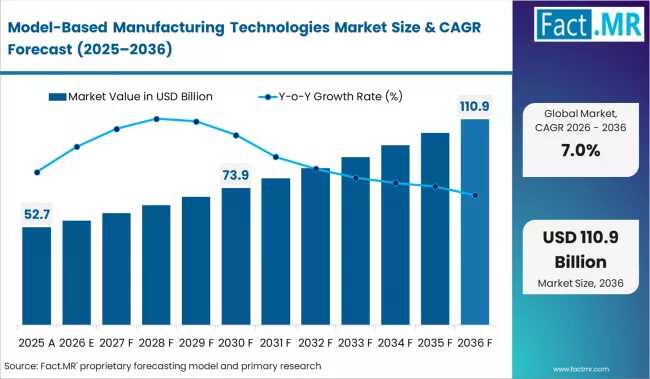
ROCKVILLE, MD, UNITED STATES, March 24, 2026 /EINPresswire.com/ -- The global landscape of industrial production is undergoing a seismic shift. According to the latest strategic analysis by Fact.MR, the Model-Based Manufacturing Technologies Market—valued at USD 60.3 billion in 2025—is projected to reach a staggering USD 118.6 billion by 2036.As organizations move away from costly physical prototyping toward high-fidelity virtual validation, the market is expected to expand at a steady 7.0% CAGR. This growth trajectory represents a new revenue opportunity of approximately USD 62.2 billion over the next decade, driven by a ""third wave"" of digital transformation: the transition from simple automation to mandatory, model-based regulatory compliance.
Get Access Report Sample : https://www.factmr.com/connectus/sample?flag=S&rep_id=14631
The Compliance Catalyst: Digital Product Passports and Industry 4.0
The primary engine behind this surge is no longer just operational efficiency; it is a matter of law. Starting in 2026, the European Union’s Digital Product Passport (DPP) mandates are making model-based tools essential for market access.
""We are moving into an era where a digital twin is no longer a luxury—it's a regulatory requirement,"" says Shambhu Nath Jha, Principal Consultant at Fact.MR. ""CXOs are currently navigating a complex post-acquisition landscape. With the blockbuster mergers of Siemens-Altair and Synopsys-Ansys redefining full-stack procurement, leadership teams must decide between committing to consolidated vendor ecosystems or seeking agile, cloud-native alternatives.""
Market Dynamics: Consolidation Meets Complexity
While the demand for Model-Based Systems Engineering (MBSE) and Digital Twin platforms is at an all-time high, the market faces unique structural shifts:
The M&A Effect: The 2025 acquisitions of Altair by Siemens and Ansys by Synopsys have created ""simulation powerhouses."" While these mergers offer unprecedented multi-physics capabilities, they are also creating temporary pressure on licensing structures, forcing enterprises to re-evaluate long-term vendor roadmaps.
Deployment Tug-of-War: On-premises solutions still command a 57% market share in 2026, fueled by the stringent security needs of the Aerospace and Defense sectors. However, a rapid migration toward Hybrid and Cloud models is underway in the automotive and medical device sectors, led by innovations from PTC and Dassault Systèmes.
The SME Barrier: High initial implementation costs remain a hurdle for smaller manufacturers. However, cloud-based ""pay-as-you-go"" models are beginning to democratize access to advanced simulation.
Regional Powerhouses: India and China Lead the Growth Race
While North America and Europe remain high-value markets, the fastest growth is occurring in the Asia-Pacific region:
India (9.7% CAGR): Emerging as the global growth leader, driven by the government’s Production Linked Incentive (PLI) scheme and massive domestic aerospace expansion via HAL and ISRO.
China (9.5% CAGR): Rapidly scaling through the Ministry of Industry and Information Technology’s (MIIT) smart manufacturing standards.
United States (9.0% CAGR): Growth is anchored by Department of Defense (DoD) digital engineering mandates and a resurgence in domestic semiconductor fabrication.
Germany (8.3% CAGR): Leading the European charge through the integration of MBSE in the automotive EV transition and DPP compliance.
Competitive Landscape & Strategic Outlook
The report identifies a highly concentrated competitive environment where the ability to offer integrated, end-to-end digital threads is the primary differentiator. Key organizations shaping the future of model-based manufacturing include:
Siemens, Dassault Systèmes, PTC, Synopsys, Ansys (now Synopsys), Autodesk, Oracle, SAP, Rockwell Automation, and Altair (now Siemens).
For investors and decision-makers, the strategic implication is clear: the window for ""wait-and-see"" on MBSE is closing. As simulation-based certification becomes the global standard, early adopters will secure a significant lead in both time-to-market and regulatory readiness.
To View Related Report:
Pipe Manufacturing Machines Market https://www.factmr.com/report/1641/pipe-manufacturing-machines-market
Cosmetic Manufacturing Market https://www.factmr.com/report/cosmetic-manufacturing-market
Additive Manufacturing Platform Market https://www.factmr.com/report/3448/additive-manufacturing-platform-market
Metal Additive Manufacturing Systems Market https://www.factmr.com/report/3283/metal-additive-manufacturing-systems-market
About Fact.MR
Fact.MR is a leading market research and consulting agency, providing deep-dive insights into the most complex industrial shifts. With a methodology combining top-down revenue analysis and primary interviews with manufacturing CIOs and procurement experts, Fact.MR delivers the data necessary for high-stakes decision-making in an evolving technological world.
S. N. Jha
Fact.MR
+1 628-251-1583
email us here
Legal Disclaimer:
EIN Presswire provides this news content "as is" without warranty of any kind. We do not accept any responsibility or liability for the accuracy, content, images, videos, licenses, completeness, legality, or reliability of the information contained in this article. If you have any complaints or copyright issues related to this article, kindly contact the author above.
