

3D Printed Prosthetics Market to Reach US$3.5 Bn by 2033 at 8.3% CAGR | Persistence Market Research
3D printed prosthetics market
3D printed prosthetics market is driven by customization, advanced materials, and growing demand for lightweight, affordable & personalized solutions worldwide
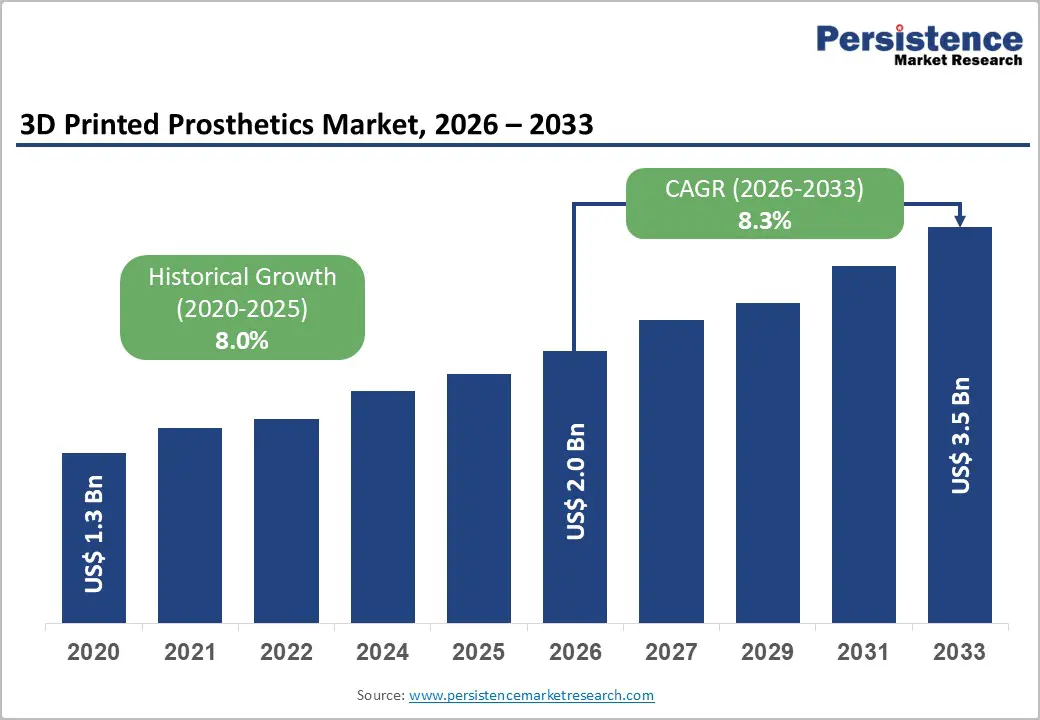
LONDON, UNITED KINGDOM, March 27, 2026 /EINPresswire.com/ -- The global 3D printed prosthetics market size is estimated at US$2.0 billion in 2026 and is projected to reach US$3.5 billion by 2033, growing at a CAGR of 8.3% during the forecast period. This growth is driven by rapid advancements in additive manufacturing technologies that enable highly customized, lightweight, and cost-effective prosthetic solutions tailored to individual anatomical and functional needs.
Market Drivers
Rising cases of limb loss caused by trauma, diabetes, vascular disorders, and congenital conditions are significantly boosting demand. Advances in biocompatible materials, 3D scanning, and computer-aided design software are improving durability, comfort, and mobility of prosthetic devices. Additionally, localized production and point-of-care 3D printing are enhancing accessibility by reducing lead times and minimizing material waste.
Download Your Free Sample & Explore Key Insights: https://www.persistencemarketresearch.com/samples/34560
Regional Insights
North America is expected to dominate the market, accounting for around 40% share in 2026 due to advanced healthcare infrastructure, strong research investment, and early adoption of innovative technologies. Meanwhile, Asia Pacific is projected to be the fastest-growing region, supported by rising healthcare expenditure, expanding manufacturing capabilities, and growing demand for affordable prosthetic solutions.
Product and Material Insights
Among product types, sockets lead the market with nearly half of total revenue share, as they play a crucial role in ensuring comfort, stability, and accurate fit. In terms of materials, polypropylene dominates due to its lightweight structure, durability, and compatibility with sterilization processes, making it ideal for prosthetic manufacturing.
Technological Advancements
Technological advancements in 3D printing are transforming prosthetic production by replacing traditional labor-intensive methods with efficient digital workflows. Technologies such as stereolithography, selective laser sintering, and fused deposition modeling enable rapid prototyping and iterative design improvements. These capabilities allow manufacturers to produce multi-material components that combine strength, flexibility, and biocompatibility.
Customization and Personalization Trends
Customization remains a key growth driver, as each patient requires unique solutions based on limb structure, muscle strength, and activity level. 3D printing allows precise tailoring of sockets, joints, and limb components, enhancing comfort and usability. It also supports aesthetic personalization, improving user confidence and acceptance of prosthetic devices.
Get Custom Insights Designed for Your Businecss: https://www.persistencemarketresearch.com/request-customization/34560
Market Challenges
Despite strong growth potential, regulatory challenges remain significant. Prosthetics must comply with strict medical standards and certifications, which can delay product approvals and increase development costs. Quality assurance is another concern, as variations in materials, printers, and processes may affect product consistency and safety. Ensuring reliable performance requires rigorous testing and standardized procedures.
Opportunities in Pediatric and Personalized Care
The market presents strong opportunities in pediatric and personalized prosthetics. Children require adaptable devices due to rapid growth, and 3D printing enables affordable and easily adjustable solutions. Similarly, adults benefit from customized prosthetics designed for specific functional and lifestyle needs, improving long-term comfort and performance.
Europe Market Trends
Europe maintains a significant position due to supportive regulations and established healthcare systems that encourage adoption of advanced prosthetic technologies. Increasing integration of digital manufacturing and research initiatives further strengthens regional growth.
Competitive Landscape
The competitive landscape is moderately fragmented, with companies focusing on innovation, customization, and strategic expansion. Market participants are investing in advanced materials, digital platforms, and localized production models to enhance efficiency and accessibility. Continuous development of high-performance prosthetic components and collaborative initiatives are expected to shape future market trends.
Checkout Now & Download Complete Market Report: https://www.persistencemarketresearch.com/checkout/34560
Market Segmentation
By Product Type
Socket
Limb
Joint
By Material
Polyethylene
Polypropylene
Acrylics
Polyurethane
By Region
North America
Europe
Asia Pacific
Latin America
Middle East & Africa
South Asia & Oceania
Future Outlook
Overall, the 3D printed prosthetics market is set for steady expansion, driven by technological progress, rising demand, and increasing focus on personalized healthcare solutions that improve patient outcomes and quality of life.
Future advancements are expected to include integration of smart sensors and artificial intelligence into prosthetic devices, enabling real-time monitoring of movement and performance. These innovations can enhance rehabilitation outcomes by providing data-driven insights to clinicians and users. Additionally, ongoing research in bio-based and recyclable materials is likely to improve sustainability and reduce environmental impact of manufacturing processes.
Collaborations between healthcare providers, technology firms, and research institutions are accelerating innovation and expanding access to advanced prosthetic care worldwide. As awareness increases and costs continue to decline, adoption of 3D printed prosthetics is expected to rise significantly across both developed and emerging markets, further strengthening growth momentum.
Read Related Reports:
Wound Antiseptics Market: Global wound antiseptics market valued at US$584.2 Mn in 2026, projected to reach US$763.6 Mn by 2033, growing at a CAGR of 3.9%.
Diabetic Gastroparesis Market: The global diabetic gastroparesis market size is likely to be valued US$ 6.8 billion in 2026 to US$ 11.2 billion by 2033, growing at a CAGR of 5.3% during the forecast period from 2026 to 2033.
Persistence Market Research
Persistence Market Research Pvt Ltd
+1 646-878-6329
email us here
Visit us on social media:
LinkedIn
Instagram
Facebook
YouTube
X
Legal Disclaimer:
EIN Presswire provides this news content "as is" without warranty of any kind. We do not accept any responsibility or liability for the accuracy, content, images, videos, licenses, completeness, legality, or reliability of the information contained in this article. If you have any complaints or copyright issues related to this article, kindly contact the author above.
