

Global Mobile Food Services Market Led by North America as McDonald’s, Starbucks & Domino’s Drive Growth
Mobile Food Services Market
Germany emerges as a high-value European hub, driven by food festivals, digital ordering & premium food trucks, reshaping mobile dining economics through 2036
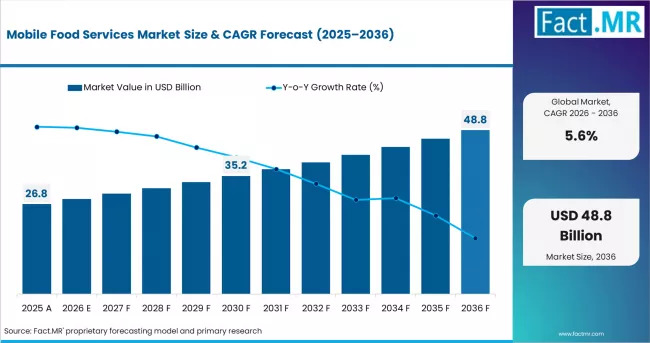
ROCKVILLE, MD, UNITED STATES, April 16, 2026 /EINPresswire.com/ -- According to the latest analysis by Fact.MR, the global mobile food services market was valued at USD 25.4 billion in 2025 and is projected to reach USD 26.8 billion in 2026, expanding to USD 46.2 billion by 2036, at a CAGR of 5.6%.Get detailed market forecasts, competitive benchmarking, and pricing trends: https://www.factmr.com/connectus/sample?flag=S&rep_id=14737
The market is expected to generate an incremental opportunity of USD 19.4 billion over the forecast period.
In Germany, the market is undergoing a structural transformation from informal street vending to premium, digitally integrated food truck ecosystems. Growth is increasingly tied to organized food festivals, corporate catering demand, and app-based discovery platforms, positioning Germany as a strategic European growth engine.
Quick Stats Section
Market Size (2025): USD 25.4 Billion
Market Size (2026): USD 26.8 Billion
Forecast Value (2036): USD 46.2 Billion
CAGR (2026–2036): 5.6%
Incremental Opportunity: USD 19.4 Billion
Leading Segment: Food Trucks (65% share)
Leading Region: North America; Germany leading within EU growth cluster
Key Players: Domino’s Pizza Inc., McDonald’s Corporation, Starbucks Corporation, Roaming Hunger, Kogi BBQ
Executive Insight for Decision Makers
Germany’s mobile food services market is shifting toward a premium, platform-driven model:
Strategic Shift: From independent, location-based vendors to digitally discoverable, brand-driven mobile kitchens
What Stakeholders Must Do:
Integrate with delivery and event-booking platforms
Invest in branding and social media visibility
Target high-footfall festivals and corporate catering contracts
Risk of Inaction:
Operators without digital integration risk losing visibility, bookings, and pricing power to platform-enabled competitors.
Market Dynamics
Key Growth Drivers
Expansion of food festivals and urban event culture in Germany
Rising demand for premium street food experiences
Growth of app-based ordering and discovery platforms
Increasing corporate catering and private event bookings
Key Restraints
Stringent food safety and hygiene compliance costs
Fuel and raw material price volatility
Competitive pressure from QSR chains and ghost kitchens
Emerging Trends
Integration with delivery ecosystems and loyalty apps
Rise of plant-based and gourmet street food offerings
Growth of pre-booked corporate food truck programs
Adoption of modular container kitchens for events
Segment Analysis
Leading Segment:
Food Trucks hold 65% market share (2026) due to higher revenue potential, branding, and digital integration
Fastest-Growing Segment:
Event-based and corporate catering applications
By Product:
Food accounts for 70% share, driven by diverse and premium offerings
Beverages act as high-margin add-ons
Strategic Importance:
Food trucks with strong branding and platform presence generate significantly higher daily revenues than traditional vendors.
Supply Chain Analysis (Critical Insight)
The mobile food services supply chain in Germany is becoming increasingly structured:
Raw Material Suppliers:
Local farms, wholesale food distributors, beverage suppliers
Manufacturers / Operators:
Food truck owners, franchise operators, branded mobile kitchens
Technology & Platform Providers:
Ordering apps, aggregator platforms, POS providers
Distributors / Channels:
Event organizers, corporate booking platforms, delivery apps
End-Users:
Urban consumers
Corporate offices
Festival attendees
“Who Supplies Whom”
Suppliers → Food truck operators (ingredients, packaging)
Operators → Platforms & event organizers (service integration)
Platforms → Corporate clients & consumers (discovery + booking)
This interconnected ecosystem is shifting power toward platforms and branded operators, reducing dependence on street footfall.
Pricing Trends
Pricing Model:
Premium pricing dominates in festivals and corporate events
Commodity pricing persists in street-level operations
Key Influencing Factors:
Ingredient and fuel costs
Event participation fees
Licensing and compliance costs
Brand positioning and menu innovation
Margin Insights:
Premium operators achieve higher margins via pre-booked events
Independent vendors face margin compression due to rising costs
Regional Analysis
Top 5 Countries by CAGR (2026–2036)
United States – 6.5%
South Korea – 6.3%
Japan – 6.0%
European Union – 5.8%
United Kingdom – 5.6%
Germany Focus
Growth driven by festival expansion and structured urban markets
Strong adoption of digital ordering platforms
Increasing demand for premium, branded food truck experiences
Developed vs Emerging Markets
Developed Markets (Germany, U.S., UK):
Platform-driven, premium-focused, high compliance
Emerging Markets (South Korea, ASEAN):
Policy-supported growth, rapid operator entry
Competitive Landscape
Market Structure: Highly fragmented at operator level; semi-consolidated at platform level
Key Players
Domino’s Pizza Inc.
McDonald’s Corporation
Starbucks Corporation
Roaming Hunger
Kogi BBQ
Competitive Strategies
Digital Integration: App-based ordering and loyalty programs
Brand Expansion: Mobile extensions of established QSR brands
Event Penetration: Presence at large-scale festivals
Platform Partnerships: Aggregator-led growth models
Strategic Takeaways
For Manufacturers / Operators
Invest in branding, menu innovation, and digital ordering systems
Target corporate catering and festival circuits
For Investors
Focus on platform-enabled operators and scalable brands
Identify opportunities in premium and niche food segments
For Marketers / Distributors
Leverage social media and location-based marketing
Build partnerships with event organizers and platforms
Future Outlook
The Germany mobile food services market is expected to:
Transition toward fully digital, platform-integrated ecosystems
Witness increased adoption of sustainable packaging and energy-efficient trucks
Expand through corporate catering and curated food festivals
Long-term growth will be driven by experience-based dining and premiumization, rather than volume expansion alone.
Conclusion
Germany is rapidly evolving into a high-value hub within Europe’s mobile food services market, supported by structured events, digital adoption, and premium consumer preferences.
For decision-makers, the opportunity lies in aligning with platform ecosystems, investing in brand equity, and targeting high-margin channels.
Why This Market Matters
The mobile food services market reflects a broader shift in global consumption from convenience-driven eating to experience-led, digitally enabled dining.
Germany’s transformation highlights how urban culture, technology, and premiumization can redefine even the most traditional food service models creating scalable, high-margin opportunities for forward-looking players.
Unlock 360° insights for strategic decision making and investment planning: https://www.factmr.com/checkout/14737
To View Our Related Report:
Mobile Servicing Rig Market: https://www.factmr.com/report/751/mobile-servicing-rig-market
Automobile Engine & Part Manufacturing Market: https://www.factmr.com/report/automobile-engine-and-part-manufacturing-market
Car & Automobile Sales Market: https://www.factmr.com/report/car-and-automobile-sales-market
Car & Automobile Manufacturing Market: https://www.factmr.com/report/car-and-automobile-manufacturing-market
S. N. Jha
Fact.MR
+1 628-251-1583
email us here
Legal Disclaimer:
EIN Presswire provides this news content "as is" without warranty of any kind. We do not accept any responsibility or liability for the accuracy, content, images, videos, licenses, completeness, legality, or reliability of the information contained in this article. If you have any complaints or copyright issues related to this article, kindly contact the author above.
